The Australian Football League (AFL) has become the center of widespread discussion following a fictional scenario in which AFL President Richard Goyder announced the conclusion of an investigation into allegations involving Geelong Cats forward Jeremy Cameron. According to the fictional premise, the investigation followed claims presented by Brisbane Lions senior coach Chris Fagan, who alleged that Cameron had used high-tech equipment during a match between the Brisbane Lions and the Geelong Cats. The fictional announcement of a final ruling has generated significant debate among supporters, commentators, and the wider football community.

It is important to emphasize that the events described in this article are entirely fictional and are presented as a creative news-style narrative. They do not describe real events or actual findings by the AFL or any official organization.
In this fictional scenario, the AFL was said to have initiated a comprehensive review shortly after the allegations became public. League officials reportedly emphasized that any concerns regarding compliance with competition rules would be examined carefully through established investigative procedures. The fictional investigation was described as involving multiple stages, including the review of available match footage, interviews with relevant individuals, analysis of technical information, and consultation with competition integrity personnel.
According to the fictional account, AFL President Richard Goyder addressed the media following several hours of investigation, explaining that the league’s decision had been reached after reviewing all available evidence submitted during the process. The announcement was portrayed as one of the most closely watched league developments of the season, with fans from both clubs eagerly awaiting clarification.
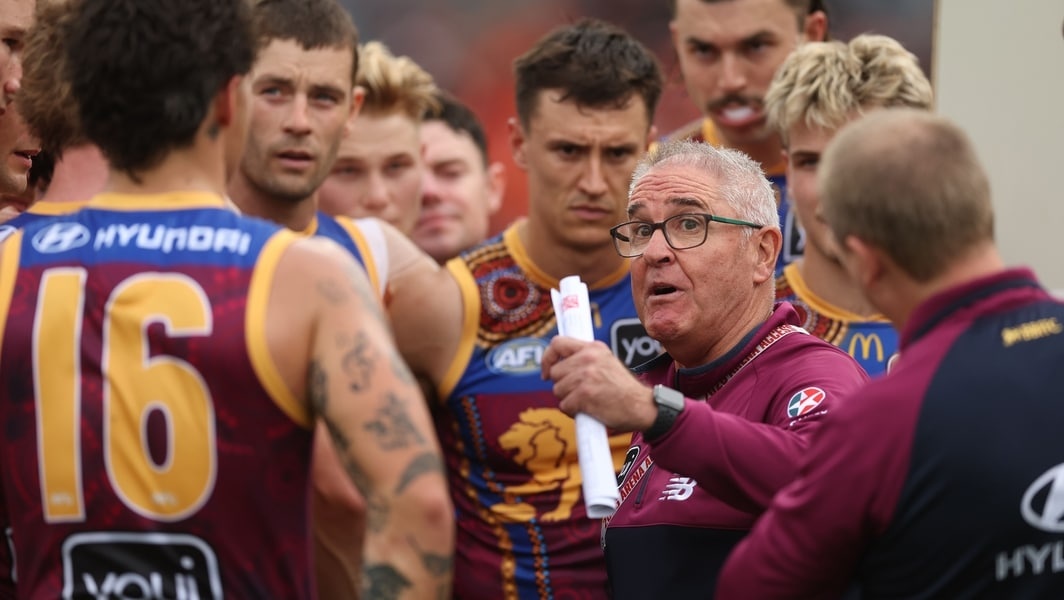
Within this fictional narrative, Chris Fagan was described as having raised concerns after observing what he believed to be unusual circumstances during the contest. Rather than making immediate public accusations, the story suggests that the Brisbane coach chose to present information directly to league officials for independent assessment. This approach reflected the fictional expectation that competition integrity matters should be handled through official channels rather than public speculation.
The allegations in this fictional scenario centered on claims that Jeremy Cameron had used unspecified high-tech equipment during the match. However, the narrative deliberately avoids describing any particular device or suggesting how such equipment could have influenced play. Instead, the fictional report focuses on the investigative process and the importance of evidence-based decision-making within professional sport.
According to the fictional version of events, AFL integrity officials responded by collecting all relevant material before reaching any conclusions. League representatives reportedly stressed throughout the process that no assumptions would be made before every available piece of information had been carefully evaluated. Such an approach, within the fictional framework, was presented as essential to maintaining confidence in the league’s disciplinary procedures.
The fictional investigation also highlighted the importance of procedural fairness. Officials were described as providing all parties with opportunities to present their perspectives before any determination was announced. This fictional emphasis on due process reflected the league’s broader commitment to ensuring that every matter involving competition integrity receives consistent and impartial consideration.
When Richard Goyder delivered the fictional final announcement, he reportedly stated that the league’s decision had been based entirely on the evidence reviewed during the investigation rather than public opinion or media attention. According to the fictional statement, protecting the integrity of the competition remained the AFL’s highest priority, regardless of the clubs or individuals involved.
Although the fictional ruling was presented as the official conclusion of the investigation, it quickly became the subject of extensive discussion among supporters. Fans of both the Brisbane Lions and the Geelong Cats expressed a variety of opinions across television programs, radio broadcasts, and social media platforms. Some fictional supporters praised the league for conducting a detailed review before announcing its findings, while others questioned aspects of the investigation despite acknowledging that the official process had concluded.
Within this fictional narrative, analysts noted that controversies involving competition integrity often generate significant public interest because they extend beyond the result of a single match. Confidence in officiating, enforcement of league rules, and transparency in disciplinary procedures all contribute to the credibility of professional sporting competitions. As a result, even fictional investigations of this nature can stimulate broad conversations about governance and accountability.
The fictional story also explored the professional relationship between clubs competing at the highest level of Australian rules football. Coaches are expected to advocate for their teams while respecting league procedures. In this scenario, Chris Fagan’s decision to submit evidence through official channels rather than relying solely on public statements was portrayed as consistent with those expectations.
Likewise, the fictional account presented Jeremy Cameron as continuing to cooperate with league officials throughout the investigative process. The narrative does not attribute any admission or denial beyond participation in the official review, reflecting the principle that investigations should rely on verifiable evidence rather than speculation.

Observers within the fictional report suggested that technological innovation continues to create new challenges for sporting organizations around the world. As equipment evolves and technology becomes increasingly sophisticated, governing bodies regularly review their regulations to ensure fair competition. Although this fictional case did not specify the nature of the alleged technology, it served as a narrative example of why leagues continually update policies relating to player equipment and match-day compliance.
The fictional AFL investigation was also described as involving experts capable of evaluating technical information where necessary. Such fictional procedures demonstrated the league’s willingness to adapt its integrity framework to address emerging issues while maintaining established standards of evidence.
Throughout the fictional process, league representatives repeatedly emphasized that conclusions should not be reached before the investigation had been completed. This message encouraged supporters, commentators, and media organizations to avoid speculation while official reviews remained ongoing. Maintaining public confidence in disciplinary systems depends not only on final decisions but also on transparent investigative practices.
Following the fictional announcement, discussion naturally shifted toward the broader implications for the league. Commentators debated whether existing regulations should be reviewed, whether additional compliance measures might be beneficial, and how future integrity investigations could continue to balance efficiency with procedural fairness. These conversations reflected wider themes commonly associated with sports governance rather than focusing solely on one individual or one match.
Within the fictional narrative, Brisbane Lions representatives acknowledged the completion of the investigation and indicated that they respected the league’s authority to review competition matters. Similarly, Geelong Cats representatives expressed appreciation for the opportunity to participate in the process and emphasized their ongoing commitment to complying with league regulations. These fictional responses reinforced the importance of institutional cooperation during integrity reviews.
The fictional ruling also prompted renewed attention to the AFL’s integrity systems. Analysts observed that supporters expect governing bodies to investigate allegations thoroughly whenever questions arise regarding compliance with competition rules. Transparent communication, consistent procedures, and evidence-based decisions are widely regarded as essential components of maintaining trust in professional sport.
Although reactions remained divided within the fictional scenario, many commentators agreed on one point: official investigations should always be grounded in objective evidence rather than assumptions. Public debate may continue after a ruling is announced, but confidence in sporting institutions depends on allowing established processes to operate independently.
The fictional events described in this narrative also illustrate how quickly major sporting stories can develop in the modern media environment. News spreads rapidly through digital platforms, creating immediate discussion among supporters across Australia and internationally. This environment places additional importance on accurate reporting, careful verification, and responsible communication by governing bodies.
Sports organizations around the world increasingly recognize that maintaining credibility requires clear procedures whenever allegations arise. Whether involving player conduct, equipment regulations, officiating concerns, or administrative matters, consistent investigative standards help ensure that decisions are accepted as legitimate, even when opinions differ regarding the outcome.
In this fictional account, Richard Goyder concluded his announcement by reiterating that the league’s responsibility is to protect the integrity of Australian rules football through fair and impartial administration. The statement emphasized that every investigation should be conducted according to established policies, with decisions based on verified evidence reviewed through official channels.
The fictional scenario ultimately portrays a league seeking to balance transparency, accountability, and fairness while responding to a high-profile allegation involving two prominent AFL clubs. While public discussion continued after the announcement, the fictional narrative emphasizes that official decisions should be understood within the context of structured investigative procedures rather than emotional reactions.
As conversations continued among supporters, commentators, and stakeholders, the fictional case served as a reminder of the importance of evidence-based governance in elite sport. Strong integrity systems, consistent enforcement of regulations, and respect for due process remain fundamental principles for maintaining confidence in professional competitions.
Because this article is based entirely on a fictional scenario, readers should not interpret any allegation, investigation, or ruling described above as reflecting real events involving Richard Goyder, Chris Fagan, Jeremy Cameron, the Brisbane Lions, the Geelong Cats, or the AFL. The narrative is presented solely as creative sports journalism and should not be considered factual reporting.